A Theological Introduction to the Old Testament Review
Van Pelt, Miles V., ed. A Biblical-Theological Introduction to the Old Testament: The Gospel Promised. Wheaton, IL: Crossway, 2016, pp. 601, $fifty.00, hardback.
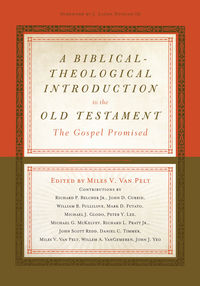 A Biblical-Theological Introduction to the Erstwhile Attestation and its New Testament counterpart are projects undertaken by the faculty, both current and past, of Reformed Theological Seminary (RTS). The projection was dedicated in honor of the seminary'due south fiftieth anniversary. Miles Van Pelt edited the Onetime Attestation volume and wrote both the introduction and the chapter on the Song of Songs.
Whereas virtually introductions to the Old Testament talk over the historical-disquisitional issues of each book, these issues have only a pocket-size role in A Biblical-Theological Introduction to the Sometime Testament. Instead, the book offers an introduction to the theological themes independent within each book of the Old Testament. After an initial section discussion on the construction and message of the Sometime Attestation, the book dedicates a chapter to each of the books in the Old Testament equally they announced in the Hebrew Bible. Each chapter is divided into sections labeled "Background Bug," "Structure and Outline," "Message and Theology," and "Approaching the New Testament." The "Message and Theology" sections make up the majority of each chapter.
The book's main force is the greater accent placed upon the theological message of each volume compared to most other Onetime Testament introductions. The authors never diminish the importance of the historical-disquisitional issues independent in most introductions, yet A Biblical-Theological Introduction to the Old Testament contains more extensive discussions of the theological message of each biblical book. The decision to focus on the theological message of each book will provide a helpful framework to guide students and pastors studying any Sometime Attestation book.
In improver to a helpful emphasis on theology, each author brings their own specialties to their contribution. For instance, some contributors develop their discussions confronting the properties of other ANE cultures, while others focus upon the literary features of the biblical text. Since this is the case, nevertheless, readers will probable find some chapters more helpful than others, depending upon their ain preferences.
Although the theological focus of this book will provide readers with a unique volume of Old Testament introduction, some elements of the book hinder it from beingness equally helpful every bit it could be. Kickoff, the books are mainly approached as isolated units rather than as parts of an integrated whole. In the Introduction, Van Pelt attempts to demonstrate how each Old Attestation volume fits together, but this emphasis is absent in many of the chapters featuring the individual books of the Sometime Testament. Furthermore, in that location is no attempt to trace specific themes, such as God's presence, covenant, or sacrifice as they are adult throughout the One-time Attestation. Each book is essentially treated in isolation from the other books.
2nd, the authors approach their tasks with a variety of methodologies, which are sometimes incompatible. For example, Van Pelt's introduction highlights the importance of the Hebrew arrangement of the One-time Testament canon (p. 25). In this arrangement, the twelve Minor Prophets are typically regarded as a single piece of work chosen The Volume of the Twelve. Yet Timmer, in his chapter on The Twelve, asserts that this arroyo neglects the individual nature of each book and that the books should be studied separately (p. 326). He discusses theological themes which appear within The Twelve, but he clearly thinks this do contains several pitfalls and the way in which he discusses the themes could be used to discuss the connections these books have in common within whatever biblical book, not just amidst The Twelve. The Hebrew organisation also places Ruth after Proverbs, but Yeo'due south chapter on Ruth only passingly refers to this arrangement and discredits its helpfulness (p. 404). Yeo is much more concerned with reading Ruth within the context of Judges and one Samuel (pp. 401–403), the arrangement found in modern Bibles, than he is the Hebrew system which Van Pelt develops within the introduction.
Third, in addition to methodological diverseness, each author seems to have a unique formulation of their assignment, and they approach their chore in a wide variety of ways. Currid, the author of the chapters on Genesis and Exodus, often discusses the theology of these books against a historical reconstruction of the beliefs of other One cultures. All the same, McKelvey, the author of the Leviticus chapter, makes no use of ANE material and attempts to draw the major theological themes actualization inside the text of Leviticus. Glodo, the author of the Numbers chapter, differs from Currid and McKelvey by attempting to give a theological summary of each section of Numbers. Redd, the author of the Deuteronomy affiliate, understood the "Approaching the New Testament" section very differently from each of the previous authors. He discusses the importance of Deuteronomy inside the Pentateuch, the Onetime Prophets, the Latter Prophets, and finally the New Attestation (pp. 152–157). Thus, fifty-fifty among the four authors who wrote capacity on the Pentateuch, their approaches to biblical theology differ widely, and they understood the goals of each section within their chapters very differently. This wide variety of approaches is typical for the residuum of the book and does not allow for a unified product to emerge.
These difficulties perhaps stem from the absenteeism of a definition of "biblical theology" at the outset of the book. Although a definition of biblical theology may seem obvious to some, when examining diverse works claiming to talk over biblical (or New or Old Testament) theology, it is apparent that biblical theology is understood in a broad variety of ways. Sometimes these differences in how biblical theology is conceived stem from significant hermeneutical differences among authors. At this point, 1 cannot just label a work as "biblical theology" and presume that this volition mean the same thing to every reader or fifty-fifty to every contributor even if they all have connections to an institution such as RTS. Since this is the case, a book that attempts to outline the theology of each One-time Testament book without a definition of biblical theology will endure from multiple approaches and lack the uniformity a reader may look when first encountering the volume. Perhaps if a definition of biblical theology had been proposed and the authors had attempted to integrate their contributions more, the difficulties noted in this review could have been resolved.
Equally noted above, these deficiencies limit the usefulness of A Biblical-Theological Introduction to the Erstwhile Attestation. The book does not provide the reader with an integrated theology of the entire Old Testament but instead a medium-length introduction to the theological contents of each book of the Sometime Testament. The capacity are more extensive than entries typically found in Bible dictionaries and nether the "theology" section of well-nigh commentary introductions yet briefer than monographs discussing theological issues of a specific book. This allows the book to fill up a gap between these two types of resource, which should be beneficial to many seminary students and pastors. Unfortunately, since at that place is little to necktie the chapters together other than a very general structural outline, it is difficult to recommend this book over other similar works such as Theological Interpretation of the Former Testament edited past Vanhoozer. Only the student'due south preference for a detail author will help him or her determine which book to consult.
Casey K. Croy
The Southern Baptist Theological Seminary, Louisville, KY
Source: https://jbtsonline.org/review-of-a-biblical-theological-introduction-to-the-old-testament-the-gospel-promised-edited-by-miles-v-van-pelt/
0 Response to "A Theological Introduction to the Old Testament Review"
แสดงความคิดเห็น